



The more popular you become on the internet, the more likely you are to encounter these risks. People want to get to know you, invite you to profitable projects, or chat with you.
However, this is not always a reason to rejoice. Often, it’s not human kindness at all. On the other side of the screen, there’s not a new friend, but rather an advanced algorithm that conducts dialogue so skillfully that you don’t notice you’re becoming prey. This is how modern scams work. Artificial intelligence is trained on millions of conversations and knows how to gain trust. It becomes the perfect conversationalist: affectionate and attentive, yet dangerous.
As the crypto market grows, so do new cryptocurrency scams. Criminals operate like startups, hiring developers and creating AI landing pages that rival high-tech Web3 projects. They flood Telegram with fake bots, turning cryptocurrency fraud into a genre of criminal art.
In this article, we will analyze new and rapidly evolving threats, examine how these schemes work, and, most importantly, explain how to recognize crypto fraud before it empties your wallet and destroys your faith in humanity.
Modern Threats in the Cryptocurrency Industry
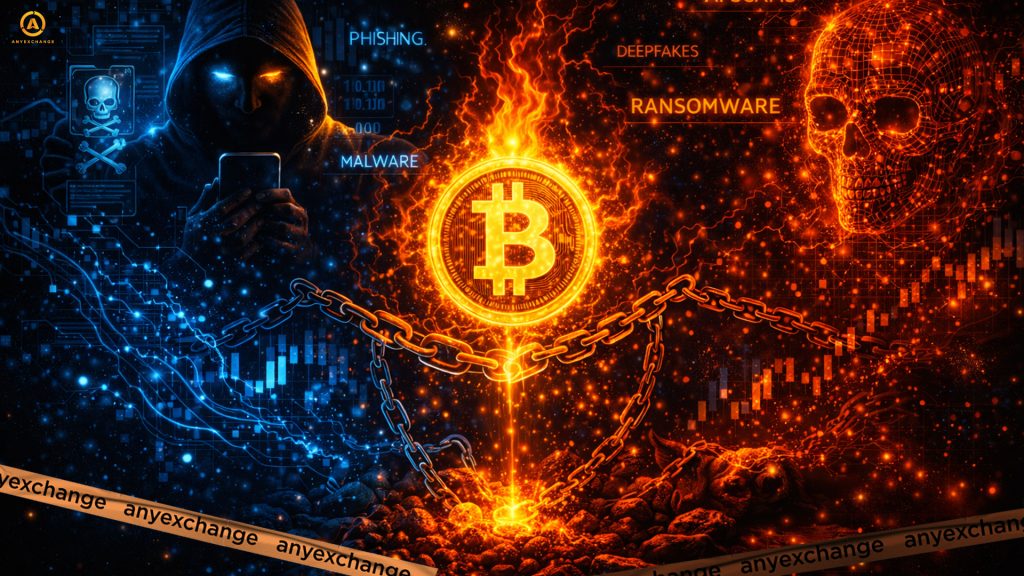
Global statistics show that cryptocurrency fraud reached new heights in 2025. This increase is fueled not only by classic pyramid schemes and phishing scams, but also by the emergence of entire “product lines of deception” built using advanced technologies.
According to Chainalysis, fraudsters obtained approximately $9.9 billion in 2024. As crypto investment scams continue to develop, analysts predict losses will reach $12 billion in 2025. The FBI’s Internet Crime Complaint Center (IC3) and TRM Labs have recorded a 66% increase in crypto-related losses in the first half of the year — $9.3 billion compared to $5.6 billion a year earlier — and this trend continues.
According to analysts, the situation is exacerbated by the following:
- A real explosion of pig butchering cryptocurrency schemes. Their profitability has grown by almost 40%, and the level of victim involvement is the highest in history.
- The rapid growth of deepfake crypto fraud. According to Bitget, SlowMist, and Elliptic, scams involving fake videos and voices account for approximately 40% of major cryptocurrency crimes, causing $4.6 billion in losses to the global industry.
- The number of fraudulent crypto platform registrations has grown from 6.4% to 9.5%, indicating the widespread use of AI to bypass security checks and launch mass phishing attacks.
Pig butchering schemes

The name of the cryptocurrency scheme, “pig butchering,” sounds harsh but is unfortunately very accurate. “Pig butchering” involves a long, painstaking process of grooming the victim. During this time, the scammer “feeds” the person with attention, care, romantic messages, and investment advice before “slaughtering” them — that is, convincing them to invest money in a fake project. This term originated in Asian criminal slang and later migrated to English-language media, becoming a common term for a trust-based scam.
Examples of pig butchering scams are simple yet ingenious in their ruthlessness. The scammer creates the image of the ideal conversation partner—charismatic, friendly, and understanding—and then leads the victim step by step to discuss investing in platforms with “guaranteed profits.” The manipulation process can last from several weeks to months. Once the victim decides to withdraw funds, the scammer suddenly demands commissions, blocks the account, and claims there are taxes to pay. The new “good” friend responds with silence.
Pig butchering fraud became an international problem in 2024–2025. According to Chainalysis and the FBI, this cryptocurrency extortion scheme has brought criminals billions of dollars, with an estimated tens of thousands of victims. In Asia, the US, and Europe, entire criminal enterprises operate on messaging platforms, turning cryptocurrency fraud on Telegram into a mass industry. Sadly, scammers use psychological methods that cause victims to lose not only money, but also emotional stability. Victims often say they feel betrayed by someone they considered close.
Deepfake and cryptocurrency scams
Previously, fraudsters had to be skilled at appearing convincing. Now, AI does it for them. Deepfake technology has become the primary tool for creating realistic videos and voice messages. For example, when a fake startup founder invites an investor to a Zoom meeting and his face slightly “floats,” the interlocutor attributes this to a poor internet connection. Similarly, when a fake company executive’s voice instructs an employee to “urgently transfer USDT to a partner address” in an audio message, the trap works because of the supposed urgency and subordination.
Deepfakes involving celebrities are a separate subtype of this type of fraud. Fake videos use fragments of real interviews, adapt lip movements, and change speech. Voilà! “Elon Musk” asks you to invest in a top-secret project. Scammers can also “turn on” a fake Vitalik Buterin who supposedly invites you personally to invest in a “revolutionary Ethereum upgrade” — which, of course, is strictly confidential and only for privileged investors. This gives victims a false sense of involvement: “If such a famous person is promoting it, then it must be trustworthy.”
These videos are so convincing today that even experienced users cannot always immediately recognize them as scams. Neural network algorithms emphasize emotions, accurately convey facial expressions, and imitate shadows and breathing. Fraudsters use AI tools to automatically generate dozens of video options and adapt them to different audiences. Consequently, cryptocurrency theft schemes using deepfake videos are becoming increasingly dangerous. Users are less likely to doubt, make decisions faster, and more often transfer money to “trusted” wallets.
AI scenarios and new methods of deception
Creating fake websites and applications using AI
Previously, scammers had to order “fake” websites from freelancers. Now, any fraudster with a laptop and a few templates can create a fake platform in five minutes that looks identical to the best ones on CoinMarketCap. Neural networks generate designs, logos, texts, user reviews, and imitation trading activity. Everything looks perfect.
Communication with victims is automated.
In 2025, criminals no longer needed to correspond with victims manually. Now, AI does it for them. Algorithms operate according to pre-designed scenarios and respond confidently, competently, and with perfect emotional adjustment. Messages are analyzed in real time, and a response that increases trust is selected: a soft tone if the person is anxious, a confident tone if they ask about risks, and a romantic tone if they are looking for love. Some systems conduct dozens of dialogues at once, simulating live communication 24/7.
Personalized Attacks Through Artificial Intelligence
AI analyzes public data on potential victims, such as their social networks, correspondence style, hobbies, and emotional reactions. AI then creates the ideal scenario, adapting its approach to the victim’s psychological profile. If the victim is interested in investments, they receive recommendations on “promising projects.” If the victim is single, a romantic angle is added. If the victim is anxious, the emphasis is on safe returns and the need to act quickly. These schemes are nothing like the classic cryptocurrency phishing attacks of 2018. They are precise and accurate, as if they had read you like an open book.
AI allows crypto fraud schemes to be scaled and attacks to be personalized. Fraudsters launch entire “character farms,” each of which is a model with a memorized communication style, history, emotional curve, behavioral patterns, and prewritten situations. Such an assistant can discuss books for hours, make life plans, joke around, and even show concern. AI can adjust the pace of communication, speeding up when the victim is engaged in conversation or “giving space” to create the impression of empathy. As a result, the person believes they are communicating with a unique personality—a friend—and not a systеm whose only KPI is to get the user to deposit money into a fake platform.
Consequences for investors and the market
Financial losses and growing mistrust
Total losses amount to billions of dollars. Even worse, these losses are becoming more concentrated. Now, a single victim can lose tens of thousands of dollars due to personalized schemes, rather than hundreds. Every new case of pig butchering, deepfake, or AI fraud increases user anxiety.
Damage to the reputation of the crypto industry
The industry’s reputation inevitably suffers when high-profile investigations into cryptocurrency scams appear and news headlines are filled with words like “fake crypto platform” or “bitcoins stolen.” Potential new users are frightened by what they hear and prefer to stick with familiar financial instruments. Experienced users become more suspicious and skeptical.
How to recognize fraudulent schemes
Signs of pig butchering and romance scams
The first thing to look out for is emotional overload on the part of the other person. If someone starts sharing personal stories too quickly and convinces you to invest in an extremely promising token at the same time, these are classic signs of a pig butchering scam. If a romantic relationship suddenly blossoms in your online communication with a stranger, be aware that you may be the victim of a romance scam. Your cryptocurrency could end up in the hands of fraudsters if you act impulsively. Other warning signs inсlude:
- requests to transfer funds to unknown or personal wallets;
- pressure to act urgently (“Registration closes in one hour!”);
- excessive emotional involvement in your personal affairs is another red flag.
Red flags for deepfake and AI scams
Deepfake and AI scenarios in cryptocurrency scams can be incredibly convincing, but there are signs that can help you spot them:
- Subtle distortions of the face or facial expressions.
- Strange shadows or lighting in the video.
- The voice sounds too flat or monotonous, as if it were synthesized.
- Repetitive phrases and canned responses in chats.
- The delivered content is overly personalized and seems too accurate.
Practical tips for protecting your investments
Follow these tips to avoid falling victim to new scams:
- Only use verified crypto exchanges, and don’t click on suspicious links.
- Check platforms’ contact details and history via Google, Reddit, and Trustpilot.
- Don’t trust “perfect conversation partners” on messaging apps.
- Use two-factor authentication and cold wallets to store large sums of money.
- Consult independent experts before making large investments.
Fighting crypto fraud
Fraudsters adapt faster than laws can be passed, but governments are trying to pick up the pace. In 2025, regulators became more active in combating crypto fraud by introducing new KYC/AML standards, expanding the powers of financial services, and creating specialized investigation units. Police and cyber units are paying attention to large-scale hackers and “pig butchering” schemes, which involve the loss of small amounts by many victims. Joint investigations between the U.S., the E.U., Singapore, and other countries are helping to track cryptocurrency scams worldwide. In some cases, it has even been possible to recover lost funds.
At the same time, exchanges are implementing preventive internal mechanisms to protect users:
- monitoring transactions and blocking suspicious addresses;
- warning users about possible cryptocurrency theft schemes;
- filters for fake applications and websites;
- video and voice verification;
- educational campaigns with advice on cryptocurrency investment security for beginners.
FAQ — frequently asked questions
- What is pig butchering, and how is it related to cryptocurrencies?
It is a scheme in which scammers “fatten up” their victims with attention, romantic correspondence, and promises of high returns. Then, they convince their victims to invest money in fake crypto projects.
- How is deepfake technology used in crypto fraud?
Deepfake technology enables scammers to create fake videos and voice messages in which “well-known personalities” or “employees” of exchanges recommend investing in a scam.
- How can you protect yourself from crypto scammers using AI scenarios?
First, don’t trust strangers. Check websites and applications. Don’t rush into investments. Consult with independent experts.
- What are the signs of cryptocurrency fraud?
- Pressure to make urgent investments and promises of “guaranteed super profits.”
- Unusually attentive or romantic messages from strangers on messaging apps.
- Fake video or voice messages that are either suspiciously perfect or unnatural.
Conclusion
Cryptocurrency fraud is more dangerous than ever in 2025. Technologies that helped develop DeFi and Web3 are now turning against the market and its users. The consequences are obvious: billions in losses and growing distrust of the crypto industry.
The main conclusion is that this situation requires a comprehensive approach. Only through the collaboration of governments, market participants, and users can we reduce damage and maintain trust.
Thank you for your attention. Invest safely and profitably!
AnyExchange is an exchanger where you can convert cryptocurrency at the most favorable rate and make secure money transfers around the world.