
After reaching peak values of around $126,000 in 2025, the Bitcoin market entered a phase of heightened uncertainty. As of the beginning of 2026, BTC is consolidating within the $90,000–$95,000 range. However, analysts are increasingly discussing the decline of the largest cryptocurrency as a logical continuation of the completed bull cycle. Historical data indicates that, after setting a new all-time high (ATH), Bitcoin often transitions into a prolonged bear market accompanied by a deep correction.
Naturally, investors are deeply concerned about how far Bitcoin might fall. Baseline forecasts suggest a decline of 40–60% from peak values, while stress models present harsher estimates.
In our article, we examine risk analyses of BTC for 2026 from leading experts, the reasons for a potential Bitcoin drop, and the scenarios under which a possible crash of digital gold could be mitigated or exacerbated. The article also provides recommendations on how investors can protect themselves during a BTC decline and amid a prolonged correction.
Why is the Bitcoin crash scenario being discussed?

In 2026, the cryptocurrency market will operate under conditions of heightened macroeconomic and geopolitical instability. Rising inflationary pressure in the U.S., Trump administration tariff policies, and slowing global growth create a persistent risk-off sentiment. In such an environment, macroeconomics becomes the determining factor in assessing Bitcoin’s price trajectory.
According to CoinShares, expectations of a more hawkish Federal Reserve stance and slower rate cuts are increasing real bond yields and reducing the appeal of risk assets. In November 2025, the crypto market lost approximately 21% of its market cap, with institutional outflows from spot ETFs surpassing $750 million. These processes intensify Bitcoin’s downside risks and shape expectations of continued declines in 2026.
Market discussions on X and in professional reports are increasingly pointing to a bearish scenario for Bitcoin in 2026. These discussions suggest that Bitcoin will decline by 42–52% from peak levels within the first months of the year.
Historical parallels with previous cycles
Historically, Bitcoin has developed within four-year cycles tied to halvings. The year following a new all-time high is typically characterized by a transition into a bear phase and a significant correction. Similar patterns were observed after the peaks in 2013, 2017, and 2021. This model often underpins estimates of when to expect a major Bitcoin decline after a bull cycle ends. Therefore, discussions of a Bitcoin crash in 2026 are statistically grounded.
- Fidelity analysts note that the market behavior from 2025 to 2026 will likely resemble that from 2018 to 2019, when BTC consolidated and gradually declined following a period of euphoria. In this context, expert forecasts for Bitcoin in 2026 suggest a base scenario of movement within the $65,000–$75,000 range.
- CryptoQuant data further confirms a slowdown in demand and conditions characteristic of a bear phase.
- Historically, corrections have reached 70–80% from the all-time high, and the Elliott Wave analysis allows for even deeper drawdowns.
The impact of macroeconomics and political decisions
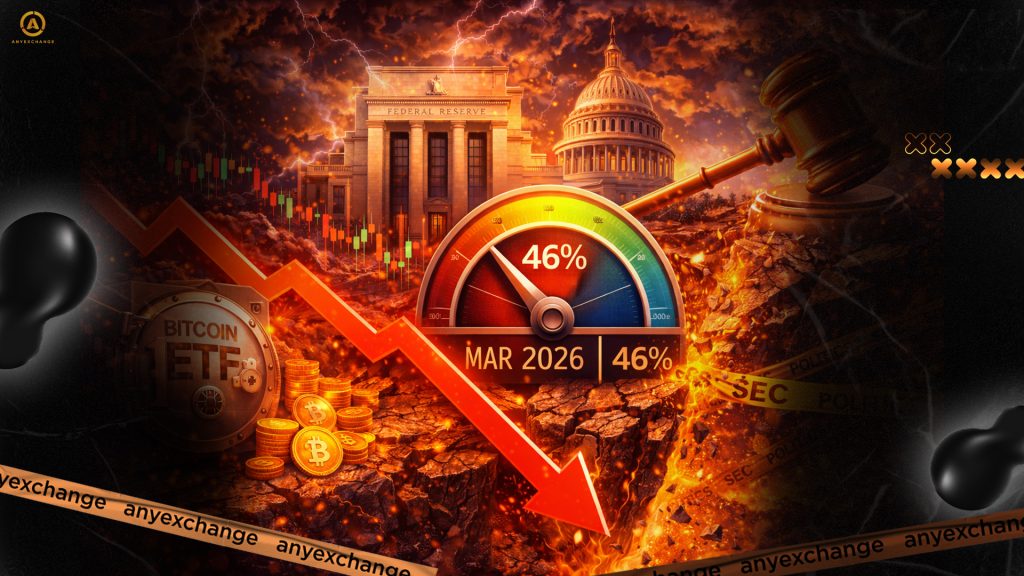
The Fed’s policy remains the primary source of pressure. The probability of a rate cut by March 2026 is estimated at roughly 46%, which reinforces the expectation of an extended period of expensive liquidity. Additional pressure comes from political risks and regulatory uncertainty. Notably, BTC declined by more than 27% in 2025, even amid ETF launches and expectations of monetary easing, underscoring the systemic nature of macroeconomic risks.
Together, these factors influence the perception of the impending correction as a normal phase in the market cycle rather than an anomaly.
Key Bitcoin support levels
A technical analysis of Bitcoin (BTC) levels is critical for assessing the depth of a potential correction. Currently, the price of BTC is holding in the $90,000–$95,000 zone, which is considered a short-term balance of supply and demand. However, if this zone breaks, market attention will shift to lower levels.
Momentum indicators remain neutral. The RSI is above 50, and the 50-day moving average is near $92,200. Nevertheless, closing below $91,357 could accelerate the decline.
Beyond the traditional Bitcoin support levels, the market is closely monitoring liquidation zones and volume clusters in 2026. The region with the most liquidity in the current market structure is around $90,500 — the midpoint of the trading range — where a significant number of leveraged positions are concentrated. Breaking through this zone could trigger a cascade of forced liquidations and amplify bearish trends throughout 2026.
Long-term levels shaped by Bitcoin cycles
- One key reference point is the $70,000 zone, which corresponds to Bitcoin’s realized price and often marks the boundary between bull and bear phases. Losing this level would significantly strengthen the bear market outlook.
- Another major support area is the $56,000 range, the historical low of the previous cycle and the correction target in baseline Bitcoin decline scenarios for 2026.
- Deeper projections based on the four-year cycle and wave analysis suggest a possible test of the $38,000–$50,000 zone during the second half of 2026.
Possible causes of a crash in 2026
The Fed’s tight policy and high interest rates
If the Fed maintains a high key rate amid “sticky” inflation, tight financial conditions may persist. This would lead to higher Treasury yields and reduce investor appetite for volatile assets.
Global Recession and Liquidity Shortage
The probability of a global recession in 2026 remains significant, especially given the current slowdown in growth and limited monetary expansion. During recessions, the price of Bitcoin typically experiences sharp, prolonged corrections. An additional risk stems from liquidity shortages. Central banks are not prepared for large-scale stimulus, and fiscal reserves are limited. Analysts warn that, in a deflationary shock scenario, Bitcoin could collapse in 2026 in a way that exceeds traditional cyclical patterns.
Institutional BTC Sales and Capital Flight
During periods of macroeconomic stress, funds and major managers reduce their exposure to high-risk assets, including BTC. In November 2025, spot ETF outflows totaled $753 million, triggering a sharp market drop. At the same time, long-term holders sold approximately 800,000 BTC, locking in profits after reaching new highs. Such institutional sales could substantially amplify Bitcoin’s downside risks in 2026.
Bearish scenario: How deep could the price fall?
Optimistic, Moderate, and Extreme Bitcoin Crash Scenarios for 2026
- The optimistic bearish scenario envisions a decline into the $70,000–$75,000 range. CoinShares and Fidelity reports indicate that the price may stabilize in this range without evolving into a prolonged crisis.
- Many experts consider the moderate scenario more likely, with the price dropping to the $56,000–$65,000 range. CryptoQuant and Galaxy Digital note that key on-chain metrics from the previous cycle cluster in this region.
- The extreme scenario is considered unlikely but possible amid a systemic crisis. According to Mike McGlone of Bloomberg, Bitcoin could fall as low as $10,000 in a post-inflationary deflation environment — an 88–90% correction from 2025’s peak values.
How will the altcoin market behave?
In a deepening bear market, altcoins usually decline more sharply than BTC. Historical precedent from 2022 shows that altcoins lost 70–80% of their value, while Bitcoin fell by a more moderate amount. A similar situation could occur if Bitcoin’s dominance rises to 57–58%. Under a bearish scenario, major projects like Ethereum, Solana, and XRP could lose 50–70% from current levels.
What could stop Bitcoin’s fall?
Interventions by large holders
Whales and corporations traditionally accumulate BTC during deep corrections. This can temporarily stabilize the price by absorbing supply. In 2026, corporate balance sheets and crypto treasuries could play a key role in viewing the decline as a long-term entry opportunity.
Improvement in macroeconomic conditions
A major reversal factor could be monetary easing. If the Fed moves toward more aggressive rate cuts amid a mild recession, pressure on risk assets will ease. In this case, the influence of macroeconomics may shift from negative to neutral or moderately positive.
Launch of New ETFs and Institutional Inflows
The introduction of additional ETFs, including instruments based on Ethereum and Solana, could boost overall market interest and soften potential declines. According to Citi, sustained institutional inflows could stabilize BTC’s medium-term price and resume growth toward $143,000–$189,000 after the correction phase. Continued buying by BlackRock and Fidelity provides long-term support despite the short-term bearish outlook for 2026.
Investor Strategy Under Risk Conditions
Beyond understanding what may happen to Bitcoin during the 2026 crisis, investors must know which strategies can mitigate losses amid high volatility and preserve capital.
- One basic approach is to diversify your portfolio, limiting your BTC exposure to 10–20%, and allocating the rest between stablecoins and defensive assets.
- Controlling risk through technical levels is also critical. Using stop orders below key zones helps limit losses.
- One of the most resilient tactics during corrections is averaging in. The DCA strategy enables the gradual accumulation of assets in potential bottom zones, such as the $70,000–$56,000 range. This approach minimizes the impact of short-term fluctuations and aligns with the projected downward phase of Bitcoin’s cyclical movement.
- Hedging via options and futures can protect against sharp drawdowns, especially during periods of high macroeconomic uncertainty.
FAQ — Frequently Asked Questions
- To what levels can Bitcoin realistically fall in 2026?
Under the baseline and most probable scenarios, analysts agree on the $56,000–$70,000 range. These values are supported by on-chain metrics and previous cycle history.
- What could trigger a significant drop in the value of Bitcoin (BTC)?
Key triggers inсlude the Fed’s tight monetary policy, a global recession, liquidity shortages, and institutional selling.
- How to recognize when Bitcoin is near the bottom?
Signals of a potential bottom inсlude extreme indicator readings such as RSI below 30, a break and stabilization below the realized price near $70,000, and slowing or reversing ETF outflows. Another indicator is declining BTC dominance, which has historically coincided with the end of capitulation phases.
- How can investors protect their capital during a market drop?
The most effective measures inсlude dollar-cost averaging, hedging, and maintaining liquidity. Using DCA, avoiding excessive leverage, and keeping part of your capital in stablecoins can help reduce losses.
Conclusion
In 2026, Bitcoin may face significant pressure from macroeconomic factors, the end of its market cycle, and institutional investor behavior. However, a crash is not a predetermined outcome. Developments will depend on the interplay of monetary policy, liquidity, and demand from large players.
According to Fidelity, 2026 is an “off year,” a time when the market cleanses itself of excessive optimism. Investors can make more informed decisions by understanding realistic scenarios, key support levels, and structural risks.
Thank you for your attention. Invest safely and profitably!
AnyExchange is an exchanger where you can convert cryptocurrency at the most favorable exchange rate and make secure money transfers worldwide.