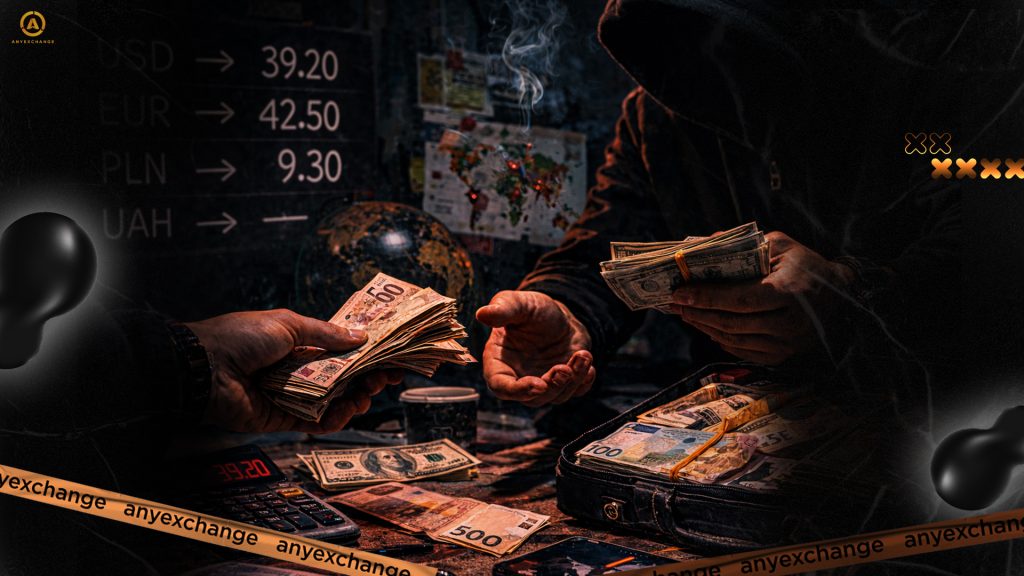
Despite the development of banking infrastructure and digital payments, millions of people around the world continue to exchange money outside the official financial systеm.
Black market currency exchange has existed for decades, particularly thriving in countries with high inflation, capital controls, or economic instability. When official exchange rates skyrocket, an alternative market emerges where the currency price is determined by actual supply and demand rather than by the government.
For instance, amid hyperinflation in Lebanon in 2026, the unofficial dollar exchange rate was more than 20 times higher than the official rate. In Iran, which is under sanctions, it was 10 times higher. In Argentina, where inflation was over 100% annually, the so-called “blue dollar” cost twice as much as at a legal exchange office.
However, the black market for cash currency is high-risk, lacking guarantees, protection of rights, and transparency. In this article, we will examine how the black market for currency exchange operates, why it continues to exist, and the risks it poses.
What is the black market for currency exchange?
Essentially, it is the buying or selling of foreign currency outside official channels, such as banks, licensed exchange offices, or regulated financial platforms.
On the black market, two parties can negotiate a transaction directly or use an intermediary, a so-called “money changer.” Exchanges can be made in cash, through transfers, or a combination of these methods. The main difference is the lack of official transaction records and, consequently, any legal guarantees.
The scheme activates when the official market fails to meet demand. For example:
- the government restricts currency purchases;
- the official exchange rate is artificially low;
- banks impose transaction limits;
- the population distrusts the national currency.
Under these conditions, an alternative market emerges where currency can be purchased freely, but at a market price rather than a regulated one.
In this context, unregulated prices also imply operating outside the legal framework. Banks and licensed exchange offices operate under the supervision of the central bank and financial regulators. They must verify client documents, record transactions, comply with financial monitoring rules, and ensure the authenticity of banknotes. However, underground currency exchangers operate outside of regulations and therefore owe nothing to anyone. They do not issue receipts, report to regulatory authorities, or bear any liability to clients. Thus, the illegal exchange of dollars and other currencies is considered a financial violation in most countries.
Despite all the risks and prohibitions, however, the black market continues to operate actively for purely pragmatic reasons.
Why do people turn to the black market?
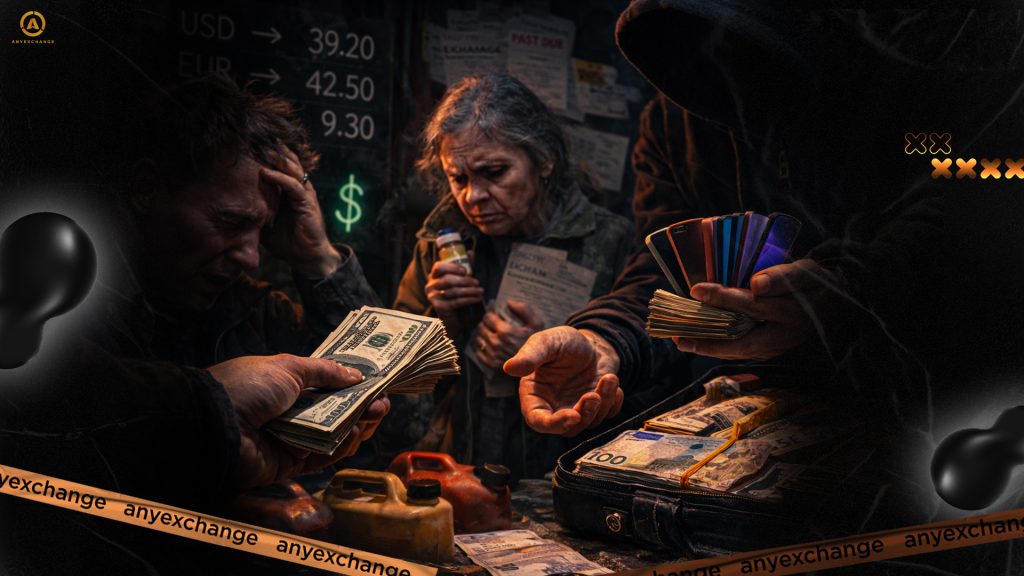
- The main reason the black market is appealing is economic profit. When the official exchange rate does not reflect the actual balance of supply and demand, a parallel systеm emerges in which money is worth whatever people are willing to pay for it. For instance, in countries with exchange controls, selling dollars can yield a significantly higher return in the local currency than through a bank. In more stable economies, the difference between bank and black market rates can be 5-15%, making illegal transactions financially attractive, especially when exchanging large sums. Another important factor is the lack of formalities. Undocumented currency exchange appeals to those who don’t want or can’t undergo bank checks. Banks must comply with financial monitoring regulations and verify their clients’ identities and sources of funds. This isn’t everyone’s preference.
- Another important advantage of exchanging money “in person” is speed, which is especially useful when people are in a hurry, such as before a trip, when paying for services abroad, or when preserving savings during economic instability. An informal transaction takes only a few minutes, whereas a bank may require waiting, verification, or pre-ordering.
- Of course, there’s also accessibility. In times of restrictions or shortages when accessing money is difficult, people begin looking for ways to exchange currency illegally through acquaintances, intermediaries, Telegram channels, or unofficial locations.
How Illegal Currency Exchange Works
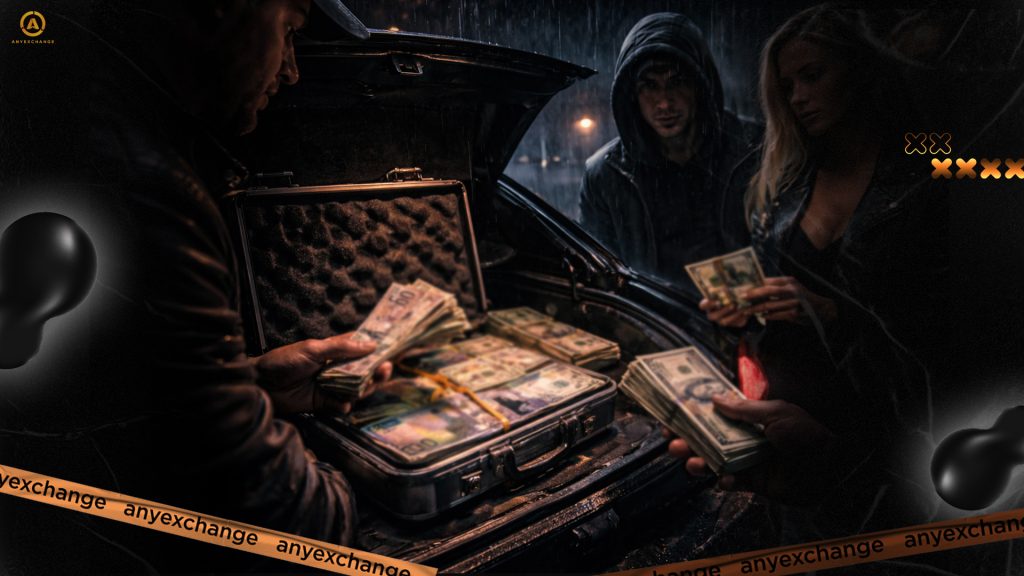
Today’s black market is far from the stereotypical “secret deal around the corner.” It’s a well-established systеm with its own rules, intermediaries, and pricing mechanisms. While it may appear to be just cash exchanges from hand to hand, behind it lies a fully-fledged unofficial infrastructure.
Illegal exchanges are conducted through intermediaries, such as money changers. These intermediaries can be individuals working independently or entire networks that regularly conduct transactions. They maintain a constant currency turnover, buying from some clients and selling to others. Intermediaries earn money on the spread; the greater the volatility, the greater their profit.
Clients negotiate via instant messaging apps, social media, or recommendations. After reaching an agreement, the parties meet in person, often near business centers, shopping malls, parking lots, or offices. Many underground exchangers disguise themselves as legitimate businesses.
The exchange rate is dynamically determined and depends directly on supply and demand. If demand for dollars rises sharply—due to economic news, for example—the price on the unofficial market rises faster than in banks. Therefore, one could argue that the black market rate often serves as an indicator of the economy’s true state, reflecting the level of trust in the national currency.
Main Risks of the Black Market for Currencies
The main problem with unofficial financial transactions is the complete lack of guarantees. Therefore, they carry all sorts of security risks. Let’s look at the most common scenarios to better understand the dangers of the black market for currencies.
- Receiving Counterfeit Money. Transactions take place without proper verification of the bills, and clients usually learn about the counterfeit bills much later—for example, when trying to deposit money at a bank. In this case, the funds are confiscated, and proving their origin is virtually impossible. This is one of the key risks of currency exchange on the black market.
- Currency exchange fraud can occur in various ways. It can occur in various ways: the client is given a smaller amount than agreed upon, some bills are swapped out secretly, or the client is pressured to speed up the process and prevent verification.
- The risks of currency exchange also inсlude a direct threat to physical safety. Since transactions take place without security or official protection, people become easy targets for thieves. Criminals deliberately stage these “transactions” to ambush clients and forcibly extort their funds.
- And, of course, you won’t be able to prove anything. Problems that arise during black market transactions are virtually impossible to resolve through law enforcement or the courts. There is no contract, receipt, or transaction record. Even if a person knows who defrauded them, legally confirming the transfer of money is extremely difficult. Therefore, before engaging in a transaction at an attractive rate, carefully consider whether it’s worthwhile to exchange currency illegally.
Legal Consequences and Liability
From a legal perspective, illegal currency exchange is considered a violation of financial laws and may result in administrative or criminal liability.
In most countries, foreign currency transactions can only be conducted through licensed banks and official currency exchange offices. Governments regulate the foreign exchange market to prevent money laundering, the financing of criminal activity, and uncontrolled capital flight. Penalties for illegal currency exchange are therefore stipulated by law in virtually all jurisdictions, from European countries to developing economies. Serious consequences may arise if the transaction involves large sums or is repeated regularly. In such cases, the activity may be classified as illegal financial activity.
Imagine if problems like fraud, robbery, or receiving counterfeit banknotes arise. If the victim reports the matter to the police, they are automatically considered a participant in an illegal financial transaction. Therefore, most such cases go uninvestigated—victims simply prefer not to report them.
Comparison: Black Market vs. Official Exchange
Let’s summarize. At first glance, the black market seems attractive because of its better rates and lack of formalities. However, upon further inspection, it becomes clear that the difference between official and unofficial exchange goes far beyond the numbers. The better rate comes with a complete lack of security.
At official exchange offices, every transaction is recorded, banknotes are verified using equipment, and customers receive documentary proof of the transaction. The banking systеm is also required to comply with all security standards and financial regulations. This rules out most fraudulent schemes.
It’s also worth considering the long-term consequences. Money received through official sources can be used freely—it can be deposited, sent abroad, or invested. Meanwhile, funds obtained on the black market may raise questions during bank checks, especially if large sums are involved.
How to Reduce Risks When Exchanging Currency
If you cannot avoid using unofficial channels altogether, be aware of the risks: you could lose money and face legal or physical threats. Try to avoid large currency exchange transactions on the black market. Pay special attention to checking banknotes. Should problems arise—for instance, if you discover counterfeit banknotes or become a victim of fraud—gather all possible evidence, such as correspondence, contacts, CCTV footage, and so on. You’re unlikely to get your money back, but having this information can be useful when contacting law enforcement.
Frequently Asked Questions (FAQ)
Can you accidentally stumble upon the black market?
Yes, and it happens more often than you might think. Underground exchangers sometimes disguise themselves as legitimate services by posting ads online, offering services via instant messaging apps, or operating from offices. Therefore, it’s important to verify that a financial intermediary has a license and to avoid offers from unregistered individuals.
What’s the most dangerous thing about exchanging money on the street?
Exchanging dollars “on the street” carries a high risk of receiving counterfeit bills, shortages, outright fraud, or physical threats. Moreover, such transactions typically occur without witnesses or documents, making it virtually impossible to prove the violation.
Do banks accept currency after an illegal exchange?
Banks accept currency if it is genuine and meets their standards. However, when depositing large sums, financial institutions are required to comply with monitoring regulations and may inquire about the funds’ origin. If an illegal dollar exchange is discovered, additional checks may be required, or the transaction may be denied. This is a common problem with unofficial currency exchanges that many people don’t consider in advance.
What should you do if a dispute arises during an exchange?
Without receipts and contracts, proving the existence of a financial transaction is virtually impossible. Nevertheless, it’s worth preserving correspondence, contacts, and any information about the other party. This information could be useful when contacting law enforcement, though the likelihood of recovering the funds remains extremely low.
Conclusion
The black market for currency exchange is a persistent phenomenon in the global economy. It is widespread in countries with inflation, currency restrictions, and unstable financial systems. Its appeal to the public lies in the ability to quickly exchange currency without a bank, get a better rate, and avoid formalities. However, any illegal financial transaction occurs outside the legal framework. This means that, in the event of a dispute or fraud, it’s virtually impossible to recover your money.
Therefore, it’s important to understand that a more favorable exchange rate on the black market compensates for the increased risk. Saving a few percent may not be worth it when considering the potential consequences, especially when dealing with large sums.
Thank you for your attention. Invest safely and profitably!
AnyExchange is an exchanger where you can convert digital assets at the best rates and make secure money transfers worldwide.