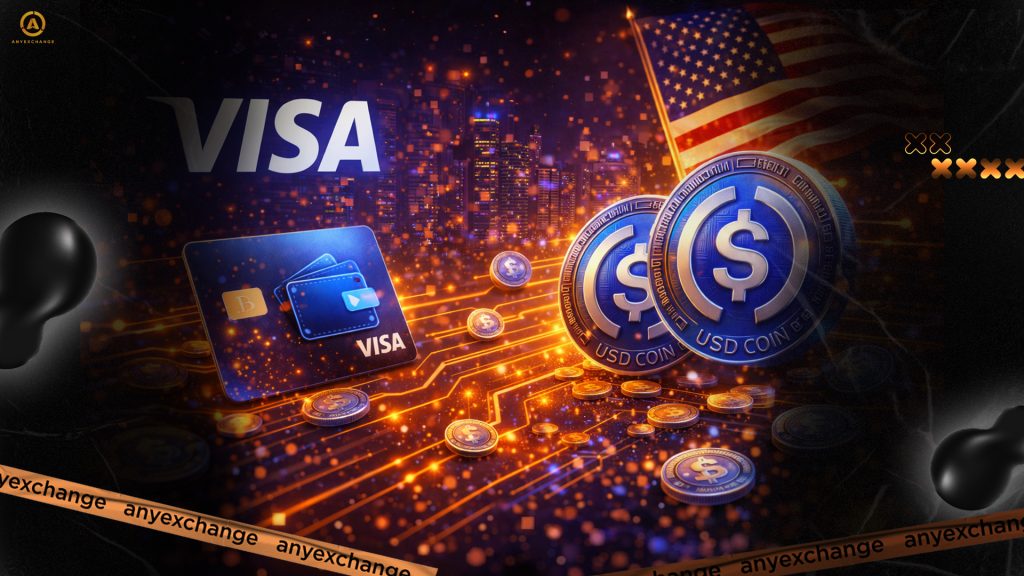
A new stage in the development of digital payments began in December 2025: Visa began offering USDC settlements to regulated US banks and fintech partners. This is a historic moment of immense significance for financial markets because, for the first time ever, the world’s largest payment network has allowed cryptocurrencies to be integrated into its key market’s settlement systеm.
Stablecoins are now part of the real financial architecture of the US, specifically its B2B infrastructure, within the Visa payment systеm. USDC payments are now used for interbank settlements between issuers, acquirers, and Visa itself.
This breakthrough was made possible by the passage of the GENIUS Act in summer 2025 and the subsequent easing of the regulatory climate. Cross River Bank and Lead Bank are the first participants to process USDC transactions via the Solana blockchain. Visa’s total stablecoin transaction volume is estimated to reach approximately $4.5 billion annually by early 2026.
Visa and Cryptocurrency: A New Stage of Development
Visa’s interest in blockchain technology has developed gradually and systematically. The company began experimenting in 2021–2023 when it launched the first stablecoin pilot programs in partnership with Circle. These programs primarily targeted Latin American and Asian markets. Over the next two years, Visa expanded its infrastructure to over 40 countries and supported over 130 stablecoin-related card programs. These steps laid the foundation for Visa’s support of digital assets to evolve from an experimental initiative into a fully-fledged business line.
Why the company is betting on stablecoins
Unlike volatile cryptocurrencies, stablecoins are ideal for settlements and clearing. Adopting stablecoins improves the efficiency of internal processes and offers banks a cheaper, faster alternative to traditional payment systems.
Following the adoption of stablecoin regulations in the U.S. under the GENIUS Act, Visa was able to integrate USDC into its American payment systеm, which had previously seemed impossible.
Visa became the first global payment network to allow USDC for payments with US financial institutions. This set an important institutional precedent. The largest traditional payment company, which processes approximately $14-$15 trillion annually, took an official position: “Not only are we not afraid of stablecoins, we are integrating them into our core business.”
What is USDC, and why was it chosen?
It is the first and, so far, the only stablecoin accepted for Visa transactions within the US.
USDC is a stablecoin with a hard 1:1 peg to the US dollar and is backed by cash and short-term government bonds.
How does USDC differ from other stablecoins? It is characterized by full compliance, transparency, and a high degree of trust. For Visa and its partner banks, it’s crucial that the settlement asset doesn’t create additional risks. In this context, USDC is perceived as a reliable digital equivalent of U.S. dollars, adapted for blockchain infrastructure. USDC is currently being adopted for use in corporate treasuries, cross-border transfers, and settlements between financial institutions.
Circle, the issuer of USDC, is considered one of the most regulated players in the digital asset market. Circle actively engages with US regulatory authorities, publishes regular reserve reports, and has built its product from the ground up with a focus on compliance with US financial regulations, which is critical for institutional participants.
How USDC Settlements Work via Visa
Transaction Mechanism
Under the new model, partner banks (card issuers and acquirers) can use USDC to fulfill their obligations to the payment network. Rather than using traditional banking rails (ACH, Fedwire, or SWIFT for international payments), transactions are processed through the Solana blockchain, ensuring high throughput and low costs. Support for Ethereum and the Circle Ark network is expected in the future.
Speed and Fees Compared to Bank Transfers
One of the new model’s key advantages is the speed and cost of USDC payments. Blockchain settlements are available 24/7/365 and take minutes, whereas traditional bank transfers can take one to five business days to process. Banks benefit from reduced operating costs and improved capital efficiency. Although Visa hasn’t publicly disclosed exact fee amounts, it is known that they are significantly lower than those of traditional banking networks, especially for large transaction volumes.
Who is the new service intended for?
It’s important to note that the new format is exclusively for institutional participants. Only regulated US banks and Visa fintech partners that meet all compliance requirements can access USDC settlements.
Businesses can use cryptocurrency payments without retail customers switching en masse to digital assets. Cardholders won’t notice any changes: payments for goods and services are made in fiat currency, and the blockchain will remain behind the scenes, performing invisible backend functions.
Impact on the Financial Market
The launch of USDC settlements in the United States is an important signal for the global financial systеm. Stablecoins are no longer just a tool for emerging markets; they are becoming an integral part of the core infrastructure of the world’s largest economy. Essentially, Visa is creating an alternative settlement layer that competes with traditional clearing systems. Competition between Visa and SWIFT is intensifying, as stablecoins offer a similar value transfer function at a lower cost without the traditional restrictions of banking business hours. Although there is no immediate talk of replacing existing systems, pressure on SWIFT, ACH, and Fedwire is increasing significantly.
Furthermore, when the world’s largest payment network officially implements USDC, trust in stablecoins among the corporate sector will dramatically increase. Companies are beginning to view stablecoins as fully-fledged financial instruments, resulting in accelerated institutional adoption.
Crypto Market and Industry Reaction
Following Visa’s December 2025 announcement, interest in integrating USDC among banks and fintech companies surged. In response to this demand, Visa launched a division called the Stablecoins Advisory Practice that provides consulting services on implementing stablecoins in payments, card programs, and treasury operations.
Impact of Visa’s News on the Stablecoin Market
Visa’s launch of domestic settlements for USDC strengthened its position as a “regulatory-friendly” digital dollar for the institutional market. This development has solidified Visa’s influence in the stablecoin market by setting a new standard of legitimacy for digital dollars. Integrating USDC into the infrastructure of the largest payment network strengthens the role of stablecoins in international payments, liquidity management, and current transactions. This turns stablecoins into a real tool for the global economy.
The stablecoin market continues to grow overall. The sector’s combined capitalization has surpassed $300 billion, and USDC has become a vital instrument for banks, fintech companies, and corporate transactions. This signaled to the industry that stablecoins are finally transitioning from an experimental stage to that of systemically important financial instruments.
Why Major Players Are Accelerating Crypto Integration
Following Visa’s move, it became clear that major financial players cannot ignore digital assets. Payment networks, banks, and processing companies now urgently need to develop their own blockchain strategies to stay ahead of the competition. Visa’s integration of cryptocurrencies into its core infrastructure and incorporation of USDC into its US payments systеm signals a new consensus on the future of the payments industry. We’re also seeing major companies use stablecoins in their operational environments rather than as pilot projects or abstract plans.
Risks and Regulatory Issues
- The use of stablecoins within Visa’s payment infrastructure is heavily dependent on U.S. regulations, which are highly sensitive to political change. Although the GENIUS Act, passed in July 2025, established the legal framework for USDC, additional reporting, reserve, and compliance requirements may be tightened.
- This means that banks and fintechs must constantly comply with AML, KYC, and financial oversight requirements. Changes in the regulatory stance could affect the pace at which companies scale USDC settlements.
- Currently, this option is exclusively available to Visa’s institutional partners. Individual users and small businesses do not have direct access to this infrastructure, which limits the technology’s impact on the retail segment. Essentially, USDC payments through Visa are an internal clearing tool rather than a mainstream payment method.
- Furthermore, only USDC is accepted within the US, with no alternative stablecoins. While this approach mitigates risks, it also slows the expansion of functionality.
- Technical aspects are also a risk factor. Settlements are processed through the Solana blockchain, which has experienced significant infrastructure failures in the past. Despite the network’s high stability in 2024–2026, the market is aware of these failures. Any technical disruptions could lead to increased caution on the part of banks and regulators.
Frequently Asked Questions (FAQ)
- Are USDC payments available to individuals?
No, currently, USDC transactions are available exclusively to regulated U.S. banks and Visa fintech partners. Individuals and Visa cardholders do not have direct access to this infrastructure. For end users, the payment process remains purely fiat and is no different from traditional card payments.
- Can other stablecoins be used?
No, not within the US. As of early 2026, Visa officially only allowed USDC to be used for settlements with U.S. financial institutions. This is directly related to regulatory requirements and the level of trust in Circle, the issuer. The future availability of other assets depends on changes in the regulatory environment.
- How does Visa ensure transaction security?
Security is ensured through a combination of traditional banking controls and the nature of the blockchain infrastructure. All settlement participants undergo strict compliance, and the transactions themselves are recorded on a public blockchain, which increases transparency.
- Is this a replacement for or a complement to bank transfers?
It is a complement, not a replacement. Banks can still use ACH, Fedwire, or other traditional channels, but USDC settlements offer a faster, more accessible alternative. This approach reduces dependence on legacy systems and strengthens the integration of cryptocurrency into traditional finance without disrupting the existing model.
Conclusion
The launch of cryptocurrency settlements was an important and pragmatic step by Visa toward integrating digital assets deeply into the traditional financial infrastructure. In fact, Visa did not launch USDC settlements as an experiment but as a working tool for regulated U.S. banks and fintech companies. This step signals that legalized cryptocurrencies have matured to the point of being used in the critical payment infrastructure of the world’s largest financial market. Visa is thus cementing its position as a technology leader and setting a benchmark for other payment networks and banks.
Clearly, Visa’s decision will significantly change the landscape of cross-border and interbank settlements in the medium term. The market already understands that the future of Visa crypto payments extends beyond niche scenarios and is a logical continuation of the evolution of the global payment systеm, in which blockchain and cryptocurrencies are becoming integral components.
Thank you for reading our article. Invest safely and profitably!