Despite the correction and some investor nervousness, expectations for Ethereum’s growth remain high: more and more analysts and market participants agree that Ethereum could reach $4,000 by the end of the year. This is not just a psychological goal; it’s an understanding of the logic of the ecosystem’s development cycle, combining technological progress, institutional capital, and a deflationary supply model.
Ethereum is primarily perceived as an infrastructure asset rather than a speculative coin, which is why its development always provokes lively debate. Let’s review what’s on the agenda for the world’s largest altcoin and the prospects experts predict for it this year.
The current situation on the Ethereum market
The price of Ethereum in dollars today (as of early February 2026) fluctuates in the range of $2,200–$2,300, reflecting a protracted correction after January highs above $3,000. At the same time, Ethereum’s price dynamics for the year remain negative. Since the beginning of 2025, the asset has lost 25–30%, indicating the current correction phase within the long-term cycle.
The next historical high for ETH was recorded in August 2025 at $4,953. The current price remains 50–52% below the peak, which largely mirrors market behavior in previous cycles. From 2021 to 2022, Ethereum corrected by 60–70% several times before beginning a new rally. This makes the current movement technically justified.
Meanwhile, Ethereum’s growth in 2025 was reflected not in price dynamics but in the development of the network itself and its economic model. Despite the decline in prices, Ethereum has achieved new scalability highs, increased the supply locked in staking, and strengthened its dominance in the DeFi and Layer 2 solutions segment. This growth in fundamentals, which is not reflected in the price, has formed the basis for current recovery expectations and strengthened long-term investor interest in ETH.
Daily trading volumes exceed $40 billion, confirming Ethereum’s high liquidity, but also highlighting increased market volatility. Such conditions create the preconditions for a new impetus: a possible ETH recovery in 2026 and its further development within this cycle. The current cycle is more mature, however, with a higher share of institutional capital and weaker speculative retail excitement. With a market capitalization of about $290 billion, Ethereum remains the second most important crypto asset, reinforcing analysts’ forecasts for its recovery and growth.
Market sentiment remains mixed:
- The Fear & Greed Index has fallen to 14, signaling extreme fear amid macroeconomic uncertainty.
- Retail investors are disappointed that Ethereum (ETH) is temporarily lagging behind Bitcoin in terms of positive price fluctuations. However, institutional investors view Ethereum as a “productive asset” with a staking yield of 3.5–4.2%.
- The professional community is discussing whether buying Ethereum is worth it now, during the correction phase.
- Most surveys show that 60–70% of market participants expect new highs in 2026, and these expectations are becoming increasingly stable.
Fundamental growth factors
Ethereum blockchain updates and ecosystem development
The main reason for Ethereum’s projected growth is large-scale technological updates to the Ethereum blockchain and ecosystem. After Pectra (Prague–Electra) was activated in May 2025, the network received improved account abstraction, which simplifies user interaction with smart contracts. It also received more efficient staking mechanisms. The December Fusaka upgrade significantly increased data throughput (blob capacity) and reduced fees on second-layer networks by 50–70%.
Following these upgrades, Ethereum continues to strengthen its position as the primary global infrastructure for DeFi, NFTs, and tokenized real assets. The Glamsterdam upgrade, scheduled for 2026 and focusing on scalability and new EIPs, further strengthens the confidence of developers and investors.
Growth of DeFi, NFT, and Layer 2 solutions
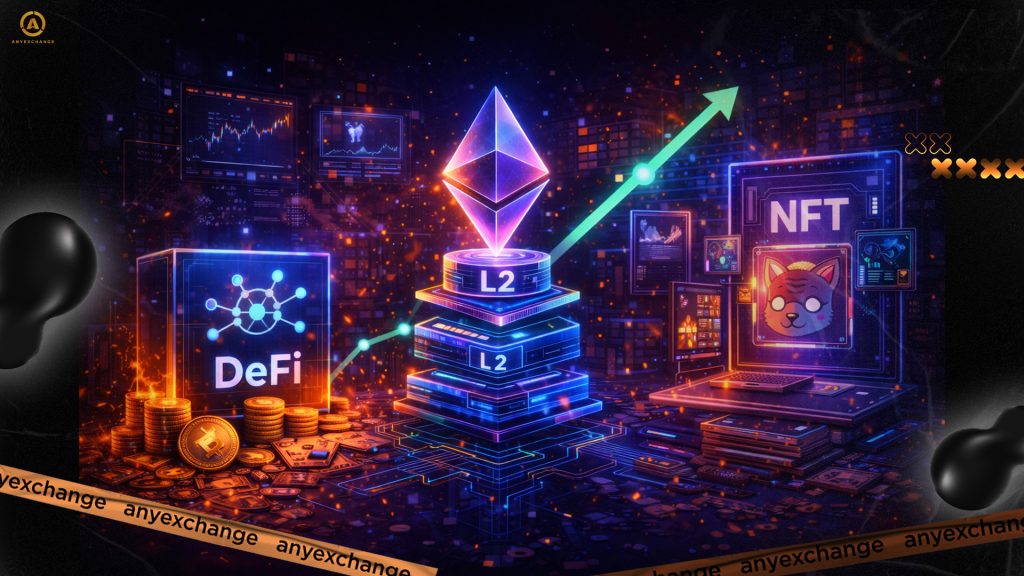
The TVL in the Ethereum ecosystem exceeds $67 billion, and Ethereum controls 60–70% of the total DeFi market. Most of the key protocols and liquidity are concentrated around the network and its L2 solutions. Ethereum’s second-layer solutions, including Arbitrum, Optimism, and Base, already process over 2 million transactions daily, twice the volume of the main layer. Reducing fees to $0.01–$0.05 stimulates mass adoption and the development of Web3 applications and NFT platforms. This growth in activity directly supports the future of Ethereum and smart contracts as the technological standard for decentralized applications.
Decrease in ETH supply and the effect of staking
Another important factor is the decrease in the supply of ETH and the effect of staking. Approximately 30–35 million ETH are locked in staking, accounting for nearly 30% of the total supply. This creates sustained deflationary pressure and enhances the asset’s investment attractiveness. The burning of fees under EIP-1559, growth in corporate reserves, and inflow of funds through ETFs are creating a structural supply deficit.
Technical analysis and key levels
Technical analysis of ETH indicates the formation of a wide sideways range after a sharp correction.
- The key support zone is in the $2,300–$2,120 range, where consolidation and active buying occurred previously. Losing this range could increase selling pressure and trigger a deeper correction.
- The market is capped by several resistance levels. The nearest level is $2,660, followed by the $2,880–$3,000 zone where the 50- and 200-day moving averages are located.
The $4,000 resistance level for Ethereum is strategically important because market participants perceive it as the boundary between the recovery phase and a bullish trend. The current chart structure is forming a contracting range, which is characteristic of accumulation. The relative strength index is in the oversold zone, which has often preceded upward reversals historically. Most experts agree that, to reach $4,000, Ethereum needs to consolidate above $3,340 with an increase in trading volume. This level would provide technical confirmation that Ethereum could reach $4,000 within the current market cycle.
The role of institutional investors
In recent years, Ethereum has firmly established itself within the field of view of major financial players. Asset management funds and corporate investors increasingly view ETH as basic infrastructure for the digital economy. Despite short-term price fluctuations, institutional investment in Ethereum continues to grow.
A significant portion of this capital comes through exchange-traded products and corporate reserves, which reduces the market’s dependence on retail traders’ speculative sentiment.
- The launch and development of spot ETFs on Ethereum represent an important structural shift for the market. Despite short-term outflows, the annual balance remains positive and assets under management continue to grow.
- Corporate investments are also increasing. Companies are using ETH as part of their crypto reserves to diversify their balance sheets. Ethereum is an attractive long-term investment for institutional investors, not only because of its potential price growth, but also because of the opportunity to earn income through staking.
Risks and potential obstacles
Crypto market volatility
Despite its strong fundamentals, Ethereum remains a highly volatile asset. Sharp price swings of 20-30% in short periods are characteristic of the market and create additional risks for short-term investors. During periods of massive deleveraging and panic selling, the price can fall much faster than expected.
Regulatory pressure and news
Delays in adopting relevant legislation, increased regulatory scrutiny, tight monetary policy, and high-profile lawsuits could temporarily reduce interest in altcoins, including Ethereum. Negative news could weaken Ethereum’s prospects this year, especially if regulatory initiatives affect staking or decentralized finance protocols.
Dependence on Bitcoin’s Movement
ETH continues to show a high correlation with BTC, and Bitcoin’s influence on Ethereum’s price remains a determining factor for the market. When Bitcoin falls sharply, the pressure automatically transfers to Ethereum, amplifying the scale of the correction. If Bitcoin falls below key support levels, Ethereum may temporarily lose momentum and enter a phase of deep consolidation.
Forecast by the end of the year
Optimistic scenario: growth to $4,000
In favorable macroeconomic conditions, Ethereum is capable of returning to active growth as early as the first half of the year. Lower interest rates, capital inflows into risky assets, and the stabilization of Bitcoin are laying the groundwork for new momentum. In this scenario, Ethereum could consolidate above the $3,300–$3,400 zone with confidence, demonstrating growth in trading volumes. Meanwhile, interest from funds and corporations would strengthen structural demand. According to experts, this development makes it possible to reasonably assume that ETH will reach $4,000 in the second or third quarter of this year.
Neutral Scenario: Consolidation
In the absence of pronounced macroeconomic drivers, Ethereum may enter a phase of protracted consolidation. In this case, the price will fluctuate within the $3,000–$3,500 range, reflecting the balance between supply and demand. This scenario aligns with market expectations and the analysts’ forecast for the Ethereum exchange rate, which allows for a longer pause before the next impulse.
Negative Scenario: Development of a Bear Market
If increased geopolitical risks occur, if there is tighter regulation, or if Bitcoin declines further below $70,000–$75,000, the market may enter a phase of deep and prolonged correction. If BTC falls below key levels, Ethereum could drop below $2,300 and retest the $2,100 support level. Even if this occurs, Ethereum’s long-term fundamental analysis remains unchanged; however, the timing of growth will be delayed.
Frequently Asked Questions (FAQ)
- When could ETH reach $4,000?
The timing depends on overall market conditions and the macroeconomic background. In a positive scenario, analysts expect movement toward the target in the second or third quarter of the year. If support above key levels is maintained and trading volumes increase, reaching $4,000 is considered the baseline scenario for market development.
- What will happen to Ethereum after reaching this mark?
After reaching $4,000, Ethereum may enter a consolidation phase or continue growing with institutional support. The subsequent dynamics depend on the pace of ecosystem development and capital inflows.
- What level is critical for growth?
The key zone for confirming the bullish trend is the $3,000–$3,340 range. Confident consolidation above this range reduces the risk of a deep correction and increases the likelihood of movement toward the next target. This is where ETH technical analysis signals a transition into a phase of sustainable growth.
- Is ETH suitable for long-term storage?
Ethereum is often viewed as an infrastructure asset with an internal economy and staking returns. Due to its deflationary supply model, Ethereum remains an attractive long-term investment option for those willing to accept volatility and dependence on Bitcoin movements.
Conclusion
Ethereum continues to maintain its status as a key infrastructure of the crypto market by combining technological development, high network activity, and sustained interest from large investors. Despite the correction, fundamental analysis indicates that Ethereum’s network is strong and capable of adapting to changing market conditions.
Increased activity in the ecosystem, scaling through Layer 2, and institutional investment in Ethereum in 2025 have laid the foundation for further price movement. Thus, with a favorable macroeconomic backdrop and market stabilization, the Ethereum price forecast for the remainder of the year allows for a scenario in which ETH approaches its target price of $4,000.
Thank you for your attention. Invest safely and profitably!
AnyExchange is an exchange where you can convert popular digital assets at the most favorable exchange rates and make secure money transfers around the world.